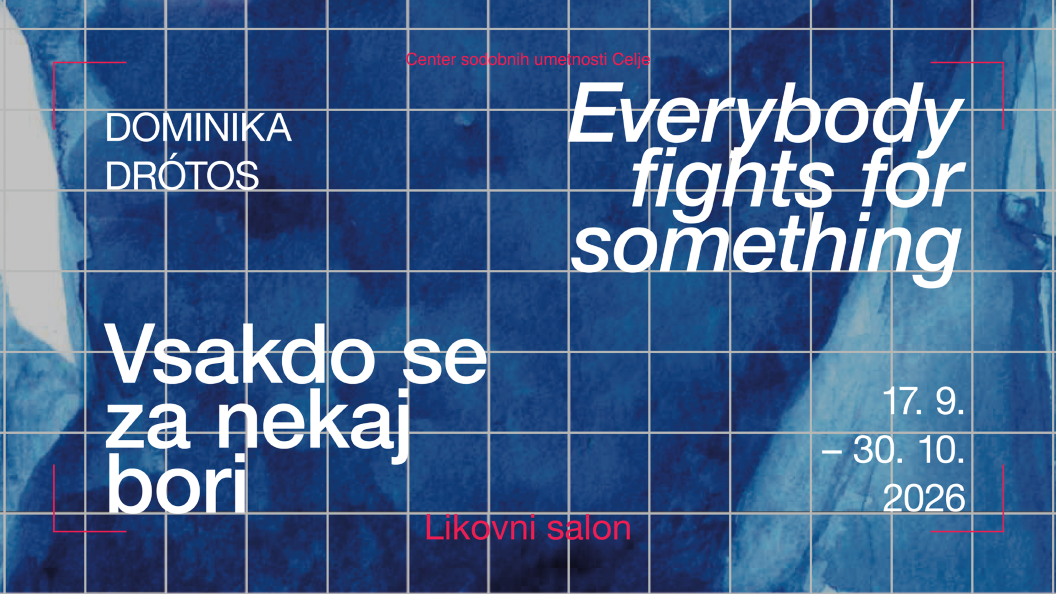
In 2025, as part of a residency exchange with the Budapest Art Gallery, the artist Dominika Drótos spent two months in Celje on a working visit, during which she devised a new project specifically for the Likovni salon Gallery.
In her work Drótos makes use of various media – she mainly uses textiles, drawings, sound, performance and installation. She works between the fields of art and activism, as she is interested in social issues and engaged practices, thus often getting involved in community projects and participatory actions. In her projects she deals with questions related to feminism, especially dealing with the invisibility of care work, which she also considers in the context of art. Her latest artistic work explores working conditions in the cultural sector, with a particular focus on the problem of unpaid or underpaid work and the precarious situation of cultural workers, characterised by constant uncertainty and a lack of basic labour rights. She is interested in structures designed to fight for the improvement of the position of cultural workers, and studies trade unions, associations and other forms of civil society organisation. During her residency, she connected with members of the Zasuk trade union for creativity and culture, with whom she conducted several interviews and gathered archive material. At the same time, she has expanded her interests to include other labour movements and has devoted herself to exploring the potential of non-violent resistance. In her work, she highlights the power of the individual and the community from the bottom up, as well as the realisation that change can be achieved through solidarity and collective action.
At the Likovni salon Gallery she uses a wall installation and an audio narrative to highlight the importance of a united and active civil society. She spent quite some time collecting photographs of protests and other images related to the activities of labour movements – both recent and historical. During her residency, she researched archival material dating from the period of socialist Yugoslavia, particularly material related to the strikes of the late 1980s. She transformed the chosen photographs into subtle, tonal watercolour drawings and then enlarged them into wallpaper patterns. Through a series of drawings, she also drew upon her experiences from her first artist residency, when she was on a working visit to Porto in Portugal. She chose the colour blue, which traditionally features on the ceramic wall tiles known as azulejos, and drew inspiration from the monumental wall mosaic at São Bento railway station in Porto. The artist replaces monumental scenes of war, national myths and colonial expansion with reproduced motifs of protests, strikes or communal gatherings, emphasising that it is precisely the everyday struggles for human rights, dignity and social justice that deserve an equal place in the collective memory.
Dominika Drótos graduated from the Hungarian University of Fine Arts and the University of the Arts London. She is currently pursuing a doctoral degree in Cultural Studies at the Academy of Fine Arts Vienna. She is a member of the Vienna-based organisation IG Bildende Kunst, a professional association and advocacy group for visual artists in Austria, which focuses on cultural policy, fair pay and social security. Since the autumn of 2024, she has been a member of the curatorial team for the Budapest Architecture Film Festival, an annual international film festival dedicated to architecture and urban life.
