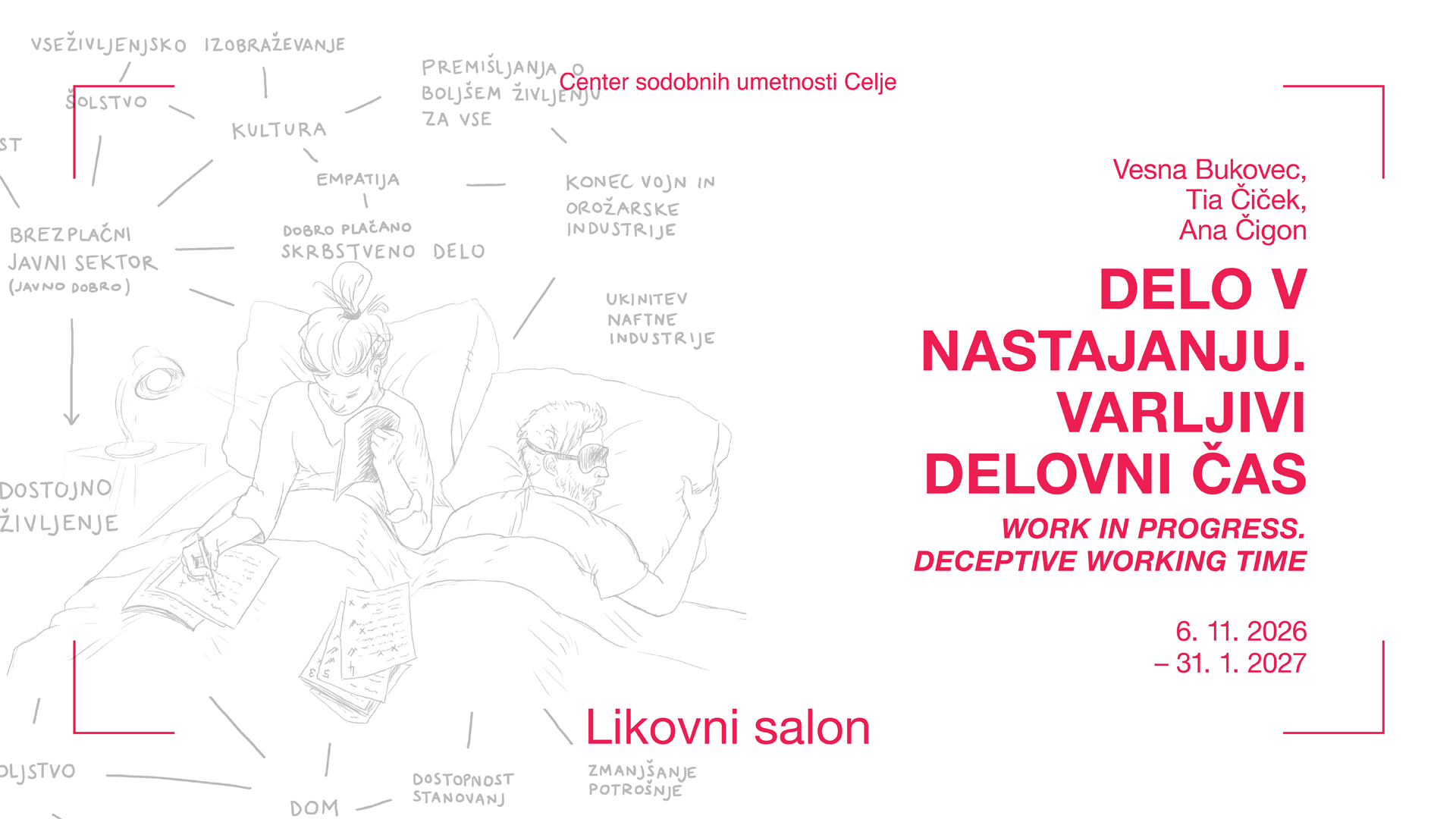
Work in Progress is a long-term artistic and curatorial research project that we – visual artists Vesna Bukovec and Ana Čigon, and curator Tia Čiček – have been developing since 2022. Using a decentralised exhibition approach, we explore the conditions of contemporary work, working hours and the possibilities for shaping alternatives to neoliberalism and capitalism.
Each iteration builds on the previous one and introduces a new point of focus: a reflection on communities beyond capitalism (Škuc Gallery, Ljubljana, 2022), utopian rest (GT22, Maribor, 2023) and the contradictions of working hours (Meduza Gallery, Koper, 2025). This exhibition showcases drawings and mind maps from various stages of the artistic research, as well as two videos: the first, The Precariat of the World … (2022), features trade unionist Tea Jarc, classical philologist, anthropologist and writer Dr Svetlana Slapšak, and Jadranka Vesel from the RISE Institute reflecting on the situation of contemporary female workers, the community and the future; the second, Deceptive Working Time from 2024, features Ajda Pistotnik, MA from the Policy Lab organisation, presenting perspectives on the organisation of work and society as proposed by the Degrowth Movement, while Professor Dr Liljana Burcar addresses the historical differences in working conditions for women under socialism and capitalism, as well as the importance of the systemic emancipation of women.
The project’s origins date back to 2020, when Ana Čigon and Vesna Bukovec suggested to curator Tia Čiček that we should organise an exhibition which would seek to answer the question: what next? Wanting to understand the contemporary approach to work and the role it plays within the current social order, we jointly set up a reading a reading group. We dedicated it to sharing knowledge and literature from the fields of labour theory, care, postcolonialism and labour movements, with the aim of unlearning the hierarchy of the values that place the product above the process, and productivity and profit above the actual worker herself.
Due to our precariousness of our everyday lives, the format of the reading circle changed from week to week. The group was getting smaller, our schedules were overloaded, and our energy levels were low. In doing so, we unwittingly confirmed to ourselves that existing work structures hinder meaningful engagement and participation rather than facilitating it. The way we worked had to adapt to bodies that were simply too tired.
However, the body is not merely an obstacle or a symptom, rather it is also a witness and an archive. The build-up of fatigue that a short weekend break cannot alleviate, the pain in the shoulders after the sixth consecutive meeting, that particular sense of emptiness at the end of a project that is referred to as burnout – as if it were a dangerous chemical reaction rather than the consequence of the normalised working conditions – all of these are bodies that speak, bodies that are reporting. Capitalist logic has taught us to interpret these reports as personal failures, as a lack of discipline or stamina. However, a body that ceases to function in accordance with productivity norms is not lying, it is merely drawing attention to the mismatch between what is demanded of us and what a human being is actually capable of enduring. Ignoring these signals, which all three of us have experienced first-hand, and the frequency with which they occur in the fields of cultural and care work, is not stoicism, but accommodation to oppression.
Degrowth (and Silvia Federici’s work before it) is a feminist theory that has shown how capitalism is transforming the bodies of female workers into machines of production and reproduction, while naturalising exhaustion as a matter of personal responsibility, not as a systemic consequence. Late capitalism has been reframing this logic as “self-care”, embedded within the paradigm of productivity. Along with the exhibition’s critical examination of the systemic causes of the exploitation – drawing on David Graeber’s Bullshits, Liljana Burcar’s The Restoration of Capitalism: The Repatriarchalisation of Society, and the anthology Degrowth: A Vocabulary for a New Era – we present the Stress Workshop by the physician and psychotherapist Tina Bončina, serving as a starting point for a collective return to the body. As in circus pedagogy, your first learn to fall, together with others, before attempting acrobatics. Falling is a technique. It may be the only fair preparation for impossible working conditions.
Vesna Bukovec, Tia Čiček, Ana Čigon
The exhibition entitled Work in Progress. Deceptive Working Time was first shown in the Meduza Gallery in 2025. The exhibition’s relocation is supported by the Ministry of Culture.
Events accompanying the exhibition
6 November, 6 pm: exhibition viewing with the participating artists
21 November, 10am–1pm: Stress Workshop, Tina Bončina
During the workshop, we will explore the basics of stress: how to recognise it, how the mind and body interact, and how burnout develops. As understanding what is happening to us often in itself reduces the pressure it causes, we will also pay attention to making sense of the situation we find ourselves in and our reactions to it. We will engage in practical exercises, focus on prevention and recognising our own patterns, learn relaxation and breathing techniques, and explore new behavioural strategies that promote well-being.
Tina Bončina, a stress and burnout expert and psychotherapist. In her work, she combines, medical knowledge with an understanding of how the psyche works – the participants thus attain deep insight into their own condition from both sides. As a Logosynthesis practitioner and trainer, she guides them towards rediscovering their own passion and energy, which allows them to perform their work with a sense of satisfaction and, most importantly, in good health. She is the author of two handbooks published by Mladinska knjiga: Burnout (Izgorelost) and Is this all there is (A je to vse, kar je).
___________
Vesna Bukovec (1977) holds bachelor’s and master’s degrees in sculpture from the Academy of Fine Arts and Design in Ljubljana. She is a socially critical artist who expresses herself through various media, with drawing – alongside video – taking centre stage. She has exhibited her work in a series of solo and group exhibitions both at home and abroad. She is also active in graphic design and the curation of video art. Since 2015, she has been a specialist associate at the DIVA Station, an archive of art video, film and new media art at the SCCA-Ljubljana.
Tia Čiček (1992) holds a master’s degree in art history and establishes alternative processes and collaborations that challenge the concept of curatorship. Driven by an interest in contemporary art, both in a broader and a local context, in 2018 they attended the Thinking with Works of Art course, mentored by Ruth Noack and Grace Samboh, as part of the International Summer Academy of Fine Arts in Salzburg, and in 2020 they completed the School for Curatorial Practices and Critical Writing at Svet umetnosti (World of Art). Between 2020 and 2025 they were the artistic director at Škuc Gallery, while they now work at the Maska Institute in Ljubljana.
Ana Čigon (1982) creates in the fields of visual art and film. Her socially critical works address themes such as historical under-representation, remembrance and public monuments, LGBTQIA+ issues, a critical approach to neoliberalism, and similar topics. She often weaves elements of humour, irony and satire into her work. She exhibits at solo and group exhibitions both at home and abroad. As a video artist, she has received the OHO Group Award, while her documentary and experimental films and animations have won several awards and been selected for the competition programmes of numerous international film festivals.
Pokrajinski muzej Celje – Center sodobnih umetnosti
Curated by: Vesna Bukovec, Tia Čiček, Ana Čigon
Text: Vesna Bukovec, Tia Čiček, Ana Čigon
Supported by: Ministry of Culture of the Republic of Slovenia, Municipality of Celje
